The most useful grocery budget is based on what your household actually spends, not on a national average. Add up four weeks of grocery receipts, turn the weekly average into a monthly figure, then set a slightly lower target you can keep with a meal plan, a list, unit-price comparisons and less food waste. Review it every few months, because food prices change.
This guide uses US statistics and an invented household in US dollars. The steps work in any country; replace the US figures with your own receipts.
What US households spend on groceries
According to the Bureau of Labor Statistics’ Consumer Expenditures release for 2025, published October 29, 2026, the average US household spent $6,491 on food at home that year, about $541 a month, up from $6,224 in 2024. Food away from home is counted separately. The figure is an average across every household size, income and region, so it describes the country rather than what your household should spend. It also covers food only; in the same release, personal care products are counted as a separate category.
Prices move, too. The USDA Economic Research Service’s Food Price Outlook forecast in its October 2026 update that grocery prices would rise 2.3 percent over 2026 as a whole. A budget set once and never checked slowly falls behind.
Set your number from your own receipts
- Collect four weeks of grocery spending. Use receipts, or your bank and card statements for the same four weeks. Four weeks smooths out a single large stock-up trip.
- Decide what counts. Many households include cleaning supplies and toiletries because they buy them on the same trip. That is fine, as long as you decide once and stay consistent. The budget categories list shows where other common costs fit.
- Find the weekly average. Divide the four-week total by four. Keep a stock-up week in the average: the food it bought is eaten in the weeks after, which usually run lower.
- Convert it to a monthly figure. Multiply the weekly average by 52 and divide by 12. A month is about 4.33 weeks, so multiplying by 4 understates a monthly budget.
- Set a target slightly below the average. Base the reduction on specific changes you can name, rather than an arbitrary round number.
A receipt log you can copy
A notebook page or spreadsheet with five columns is enough to keep the four weeks straight:
- Date and store
- Total paid
- Non-food items on the same receipt, such as cleaning supplies, if you count them separately
- Stock-up items bought for later weeks
- Items that went unused or were thrown away
The last column is the one most people skip, and it shows where the easiest savings are. The expense tracker can total the paid column by category if you prefer to enter receipts on screen.
Example: from receipts to a weekly target
This invented household of three tracks four weeks of grocery receipts:
| Week | Spent |
|---|---|
| Week 1 | $152.40 |
| Week 2 | $168.75 |
| Week 3 | $131.10 |
| Week 4 (stock-up trip) | $187.75 |
| Total | $640.00 |
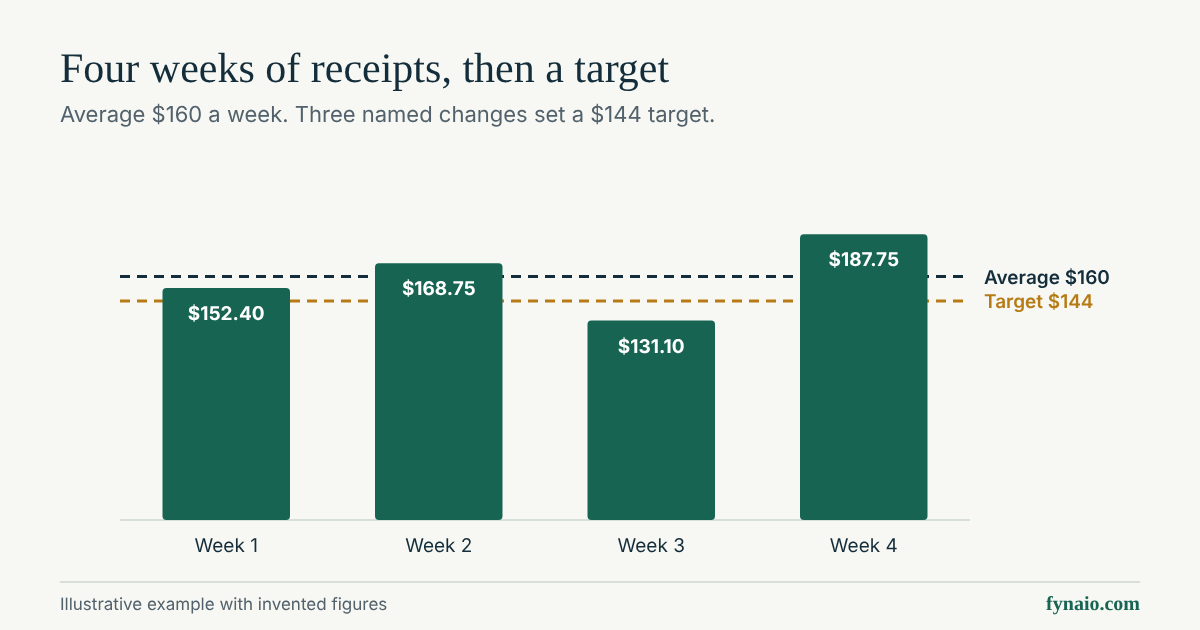
The weekly average is $160.00 ($640.00 ÷ 4). As a monthly figure, that is $693.33 ($160 × 52 ÷ 12). Rather than picking a round number, the household lists three changes and estimates what each one saves:
| Change | Saved per week |
|---|---|
| Shop from a meal-based list and skip unplanned extras | $7 |
| Switch three staples to a lower unit price | $5 |
| Use leftovers and the freezer before buying more | $4 |
| Total | $16 |
The new target is $144 a week, or $624 a month ($144 × 52 ÷ 12). Saving $16 a week adds up to $832 over a year. The estimates are deliberately modest: check them against the next four weeks of receipts and adjust if they were too optimistic.
A weekly routine for shopping on a budget
The Environmental Protection Agency’s guide to preventing wasted food at home recommends checking what you already have and planning meals before you shop. The first three steps below follow that advice; the rest add a spending cap and a record:
- Check what you have. Look in the fridge, freezer and cupboards before writing anything down.
- Plan the week’s meals. Count how many meals you will really eat at home, and plan some that use up what you already have.
- Write the list from the meals. Note how many meals each item covers, so you buy enough and no more.
- Take the week’s limit with you. Use the weekly target as a cap, either as cash in an envelope or as a running total on your phone.
- Compare by unit price. Look at the price per ounce, pound or item rather than the package price.
- Check the receipt against the list. Unplanned items stand out on a receipt, which makes them easier to leave out next week.
- Record the total. Four weekly totals give you next month’s average.
Ways to lower the grocery bill
- Let unit prices pick the size and brand. The National Institute of Standards and Technology’s unit pricing guide sets out a best-practice way for stores to show the price per unit so shoppers can compare. Shelf labels are not always consistent, so the unit price calculator can do the comparison for you, even across different package sizes.
- Consider imperfect produce. The EPA notes that imperfect produce may have physical flaws but is just as safe and nutritious, and is sometimes sold at a discount.
- Buy in bulk only what you will use. A lower unit price saves nothing if part of the pack is thrown away. The Food and Drug Administration advises care with bulk buys, especially of items with a limited shelf life.
- Judge food spending as a whole. If you cook more at home to cut restaurant spending, expect the grocery number to rise. Compare the combined food figure, not groceries alone.
Waste less of what you buy
Food you throw away is part of your grocery bill. The EPA estimates that the average family of four spends almost $3,000 a year on food that does not get eaten, and that throwing away less could save such a family up to $56 a week. The $16 a week in the example above is less than a third of that figure.
Date labels cause some of the waste. The FDA’s tips to reduce food waste say confusion over date labeling accounts for an estimated 20 percent of consumer food waste. Except for infant formula, manufacturers are not required by federal law to put quality-based dates on packaged food, and a “Best if Used By” date describes when food is at its best quality. After that date, the FDA suggests checking food for signs of spoilage; if its color, consistency or texture has noticeably changed, you may want to avoid eating it. This is US guidance, and labels work differently in other countries.
The EPA’s storage tips help the rest of the plan stick: freeze food you will not eat in time and label it, keep leftovers in clear containers marked with the date, and store fruits such as bananas and apples away from other produce.
Keep the budget current
Recheck your number every three to six months with two weeks of receipts, and whenever the household changes: a new baby, an older child eating more, guests staying or a new diet. Prices matter as well. Applying the 2.3 percent forecast to the example household’s $624 target adds about $14 a month ($624 × 2.3% = $14.35). If your receipts run above the target month after month even with the routine above, raise the target rather than abandoning the budget.
When these numbers do not fit
- Medical or special diets. Prescribed or allergy-safe foods can cost more. Give them their own line rather than squeezing them into a general target.
- Infants. Infant formula is the exception to the FDA’s date-label rule. Follow its date rather than stretching supplies to save money, and plan for it as a separate line.
- Limited store access. If your nearest store has few choices, unit-price comparisons still help, but your number may stay above the averages.
- Large households. National averages hide big differences by household size; your own receipts are the better guide.
- Outside the US. The BLS, USDA, EPA and FDA figures are US-specific. Use your own receipts and local statistics instead.
This is general information, not dietary or financial advice for your situation.
Add it to your monthly budget
Once the weekly target holds for a month, put the monthly figure into your budget so the rest of the plan reflects it. The monthly budget template has a grocery line, and any money the new target frees up can go toward a goal in your wider savings plan.