Envelope budgeting, also called the cash envelope system, means giving each everyday spending category its own fixed amount and keeping that money apart, in a paper envelope or a digital one. You pay for groceries only from the grocery envelope, fuel only from the fuel envelope, and so on. When an envelope is empty, you either stop spending in that category until the next refill or move money in from another envelope on purpose and write the move down.
This guide covers which costs belong in envelopes, how to fill them on payday, what to do when one runs out, and how to run the same system without cash. It uses US sources and an invented example in US dollars; the method itself works in any currency.
How does envelope budgeting work?
The method comes down to four rules:
- Pick the categories. Choose the flexible costs you pay in many small amounts, such as groceries, fuel and eating out.
- Fill each envelope when you are paid. Put the planned amount for each category in its envelope, or move it to its digital equivalent, on the day the money arrives.
- Spend only from the matching envelope. A grocery trip is paid from the grocery envelope, even if another envelope has more in it.
- Treat an empty envelope as a decision. Either wait for the next refill or move money in from another envelope and note the change.
The Consumer Financial Protection Bureau suggests a version of this in its ideas for financial educators on managing spending: pick a monthly amount for a category such as special occasions, write it on an envelope, keep that category’s receipts inside and total them at the end of the month. If the total is over budget, the difference comes out of the next month’s amount.
Envelope categories: which expenses belong in envelopes
Envelopes suit spending that changes from week to week and that you decide on in the moment. Fixed bills are better paid straight from your bank account on their due dates, because the amount is already known and many are paid automatically.
| Good fit for an envelope | Usually better as a bill paid from your account |
|---|---|
| Groceries and household supplies | Rent or home payment |
| Fuel and parking | Utilities, phone and internet |
| Eating out and takeaway | Insurance premiums |
| Personal spending money | Loan and card payments |
| Gifts and occasions | Subscriptions billed automatically |
Utilities sit in the bill column because they are usually paid from your account on a due date, not because the amount is fixed. Heating, cooling and water bills can change a lot between seasons, so plan from a recent high month or a twelve-month average and leave the difference in your account rather than in an envelope.
If you are not sure where your money goes, the list of budget categories covers the common monthly costs and the irregular ones people forget. Starting with four to eight envelopes keeps the system manageable; you can split one later if you want to watch it more closely. If groceries are one of your envelopes, the grocery budget guide shows how to set that amount from your own receipts.
Example: a month of envelopes on two paychecks
This invented household is paid twice a month. Rent, utilities, insurance and other bills are paid from the bank account first. The money left for everyday spending is divided into six envelopes, filled with the same amounts each payday.
| Envelope | Each payday | Per month |
|---|---|---|
| Groceries | $260 | $520 |
| Fuel | $90 | $180 |
| Eating out | $60 | $120 |
| Household supplies | $35 | $70 |
| Personal spending | $50 | $100 |
| Gifts and occasions | $25 | $50 |
| Total | $520 | $1,040 |
On the 12th, the eating-out envelope is empty after a birthday dinner. The household moves $20 from personal spending to eating out and writes the move on both envelopes. Total planned spending stays at $1,040; only the split changes, with personal spending at $80 for the month and eating out at $140.
At the end of the month, $34 is left in groceries and $12 in fuel. The household decides what that $46 does next: stay in those envelopes as a cushion for next month, or move to a savings goal. Either works, as long as it is a decision rather than money that quietly disappears. The savings goal calculator shows how a regular amount like this adds up toward a target.
Keep a simple envelope ledger
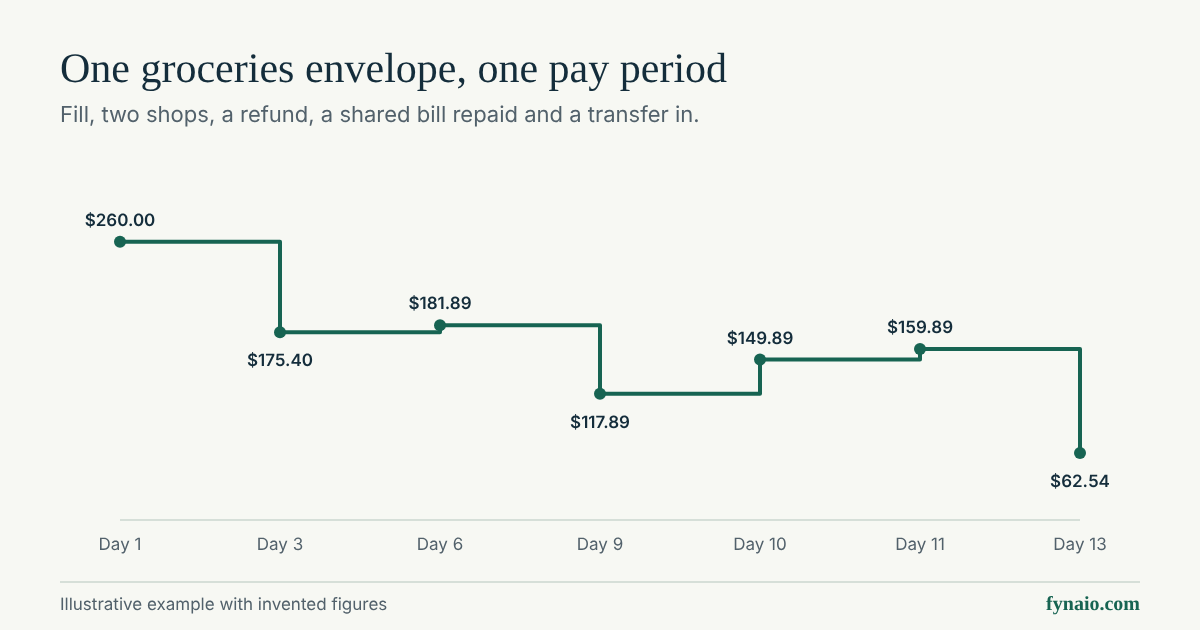
An envelope only works if its balance is right. A short ledger on the envelope, or one row per entry in a spreadsheet, keeps it right when the month gets messy. Here is the groceries envelope for one pay period in a different invented month, with a refund, a shared bill and a transfer:
| Day | Entry | In | Out | Balance |
|---|---|---|---|---|
| 1 | Payday fill | $260.00 | $260.00 | |
| 3 | Supermarket | $84.60 | $175.40 | |
| 6 | Refund for a returned item | $6.49 | $181.89 | |
| 9 | Shared shop, paid in full | $64.00 | $117.89 | |
| 10 | Housemate repays half | $32.00 | $149.89 | |
| 11 | Moved in from household supplies | $10.00 | $159.89 | |
| 13 | Supermarket | $97.35 | $62.54 |
Three rules keep the balance honest:
- Refunds go back where the money came from. The $6.49 returns to groceries, not to whichever envelope is running low.
- Record a shared bill in full, then the repayment. Writing $64.00 out and $32.00 in shows that the envelope really carried $32 of shared cost, and that the repayment arrived. If it never arrives, the ledger shows that too.
- Write every transfer on both envelopes. The $10.00 appears here as money in and on the household supplies envelope as money out, so the total plan does not change.
The day before payday the household counts $62.54, the same as the ledger, and decides where it goes. If the count and the ledger disagree, a receipt is usually missing. For digital envelopes, the expense tracker totals card and cash purchases by category, which gives you the out column without adding receipts by hand.
Cash envelopes, digital envelopes or both
Paper envelopes make the remaining balance visible at a glance: you can count what is left before you spend. But most payments are no longer made in cash. In the Federal Reserve’s 2026 Diary of Consumer Payment Choice, based on a survey of US consumers in October 2025, credit and debit cards accounted for two-thirds of all payments. Cash was still common: four in five consumers had used it in the previous 30 days, and 76% carried some, with an average of $69.
For many households that points to a mix:
- Cash envelopes for categories you mostly pay in person, such as groceries, fuel or a weekly personal allowance.
- Digital envelopes for categories paid online or by card. These can be separate bank accounts, labelled sub-accounts if your bank offers them, or one spending account with a running balance for each envelope in a spreadsheet such as the monthly budget template.
Cash carries a practical risk. The CFPB’s guide to building an emergency fund reminds readers that cash can be stolen, lost or destroyed, so keeping only one pay period’s envelope cash at a time limits what you could lose. Money that stays in a bank account keeps its protection: the FDIC says deposits are insured to at least $250,000 at each FDIC-insured bank. That is a US protection, and it does not cover cash kept at home.
Cash stuffing is the same method
Cash stuffing is a newer name for the cash envelope system: withdrawing your planned everyday spending on payday and dividing it into labelled envelopes, often kept together in a wallet or binder. The rules above apply unchanged. Three habits make it easier to keep up:
- Withdraw only what the envelopes need for the next pay period, not a round number.
- Keep receipts in the matching envelope. The CFPB’s spending tracker suggests a small container or envelope for every receipt, so each category can be totalled later.
- Count each envelope the day before payday and record what is left before you refill it.
What to do when an envelope runs out
- Wait if you can. If the next refill is a few days away and the purchase can wait, waiting costs nothing.
- Move money deliberately. Take it from an envelope that will not need it this period and write the transfer on both, as in the example above. Your total plan stays the same.
- Leave bill money alone. Rent and utility money is not an envelope to borrow from, and a missed bill can bring late fees.
- Fix the amount, not just the month. If the same envelope runs out three months in a row, its planned amount is probably too low. Raise it and lower another envelope so the numbers match how you actually live.
How envelopes fit with other budgeting methods
Envelope budgeting controls spending; it does not decide how much each category should get. It pairs well with methods that do:
- Zero-based budgeting assigns every dollar of income a job. Envelopes are a natural place to hold the dollars assigned to flexible spending.
- The 50/30/20 rule splits take-home pay into needs, wants and savings. Dividing the wants share into envelopes stops it leaking into other categories.
- A first budget starts with income and a list of expenses. Once that list exists, its flexible lines are the obvious candidates for envelopes.
Benefits of envelope budgeting
- A hard limit on flexible spending. Each category has a set amount, so overspending in one place cannot quietly use money meant for another.
- You can see what is left. A glance at an envelope or its digital balance shows how much remains until the next refill, without adding up receipts.
- Overspending becomes a choice. Moving money between envelopes is a decision you write down, which makes it easier to notice which categories need a bigger amount next month.
These benefits depend on following the rules every time. They do not lower your costs by themselves, and the method does less for fixed bills that are already paid automatically.
When envelope budgeting is a poor fit
- Most of your spending is online or automatic. A paper envelope cannot pay for an online order. Use digital envelopes, or keep envelopes only for the few categories you pay in person.
- Your income changes from month to month. Fill envelopes only as money arrives, essentials first, and keep the amounts per pay period rather than per month.
- You share costs with someone else. Agree who refills each envelope and who can spend from it, or keep separate personal envelopes alongside shared ones, and record shared bills and repayments as in the ledger above.
- Carrying cash is not safe for you. Keep every envelope digital. The method works the same way.
This is general education, not personal financial advice. If you are behind on essential bills, deal with those first; envelopes are for organizing the money left after them.
Set up your envelopes in an hour
- Go through last month’s bank and card statements and total your flexible spending by category.
- Choose four to eight envelopes from those categories.
- Subtract fixed bills and savings transfers from your take-home pay to find what the envelopes can share.
- Give each envelope an amount, and check that the total does not exceed that figure.
- Decide which envelopes will be cash and which digital.
- Fill them on payday, with the same split each time.
- Keep receipts in the matching envelope and record every purchase, refund and transfer in its ledger.
- The day before the next payday, count what is left and decide where any leftover goes.
- After a month, adjust any amount that was clearly too high or too low.