Most household budgets need categories in three groups: essential costs you must pay (housing, utilities, food, transport, insurance and health), flexible spending you choose (dining out, entertainment, shopping and subscriptions), and money for the future (an emergency fund, savings goals and set-asides for bills that do not arrive every month). Below is a list of monthly expenses you can copy, starting with basic living expenses, plus irregular costs that are easy to miss. No list covers every household, so add anything your statements show that is not here.
Examples use US dollars. The household example is invented for teaching.
Basic living expenses
Living expenses are the costs of running a household: housing, utilities, food, transport, health care and the minimum payments on debts. They keep a roof over your head and let you get to work, so list them first. This is the essential part of your monthly expenses list:
- Housing: rent or home payment, renters or homeowners insurance, property taxes, HOA or building fees, repairs.
- Utilities: electricity, gas or heating fuel, water and sewer, trash collection.
- Food at home: groceries and household basics such as cleaning supplies and toiletries.
- Transportation: car payment, fuel, car insurance, maintenance, parking, tolls, public transit.
- Health: health insurance premiums, copays, prescriptions, dental and vision costs.
- Phone and internet: mobile plan and home internet.
- Childcare and dependents: daycare, school costs, child support you pay.
- Required debt payments: the minimum due on each debt.
Flexible spending
These are real costs too, and leaving them out is the fastest way to a budget that does not survive the month. Give each one a realistic amount based on your statements.
- Dining out: restaurants, takeout, delivery, coffee.
- Entertainment: events, hobbies, games, outings.
- Subscriptions: streaming, apps, memberships, software. Review them regularly; here is how to cancel the ones you no longer use.
- Shopping: clothing, home items, electronics.
- Personal care: haircuts, cosmetics, gym.
- Giving: donations and gifts outside the holidays.
- Travel: trips and weekends away.
Savings and future costs
Treat these as categories, not leftovers. Money assigned here has a job just like rent does.
- Emergency fund: savings for unplanned costs or a loss of income. The emergency fund guide explains how much to keep, and the emergency fund calculator turns your essential costs into a target.
- Savings goals: a specific purchase, a move or a trip.
- Retirement contributions you make yourself, outside of payroll.
- Set-asides for irregular bills, covered in the next section.
Irregular costs people forget
Bills that arrive once or a few times a year are easy to miss because they do not appear on a typical month’s statement. Go back through a full year of statements and look for these:
- Car registration, inspection and license renewals
- Insurance premiums paid every six or twelve months
- Annual memberships and software renewals
- Holiday gifts, birthdays and celebrations
- Back-to-school supplies and activity fees
- Medical deductibles and dental work
- Car repairs, tires and home maintenance
- Pet care and vet visits
- Professional fees, such as tax preparation
Turning annual costs into a monthly line
The fix for irregular costs is to divide each one by 12 (or by the months until it is due) and set that amount aside every month. In this invented example, a household lists its known annual costs:
| Annual cost | Per year | Per month |
|---|---|---|
| Car registration | $180 | $15 |
| Car insurance (paid twice a year) | $1,080 | $90 |
| Holiday and birthday gifts | $600 | $50 |
| Pet care and vet visits | $360 | $30 |
| Total | $2,220 | $185 |
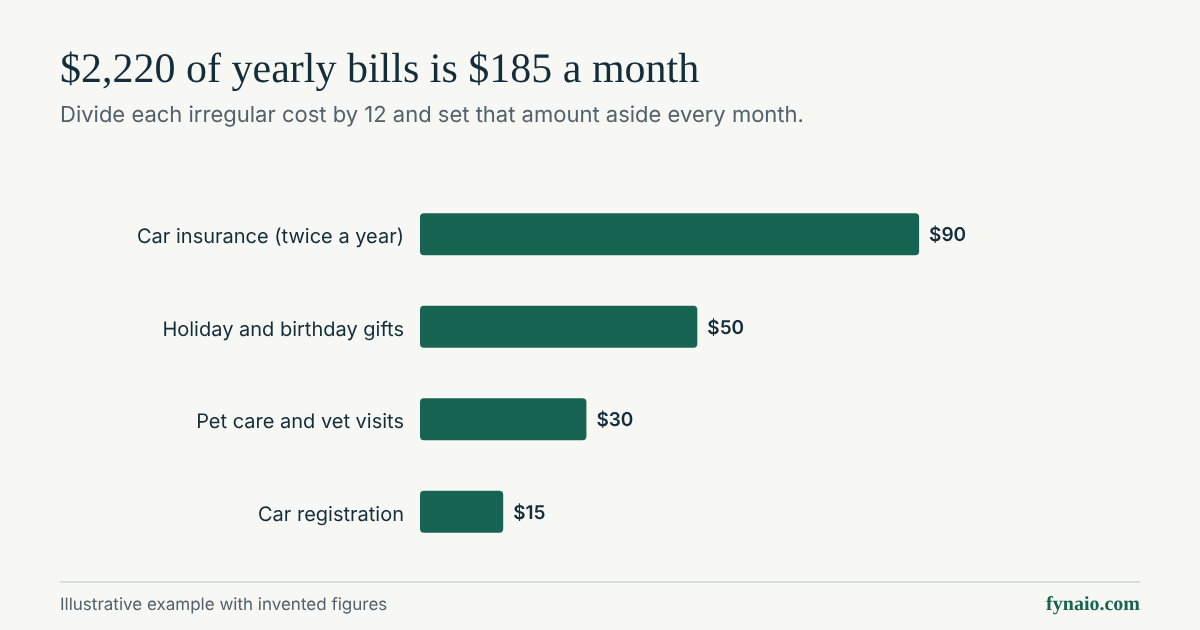
Setting aside $185 a month means each of these bills is already covered when it arrives. Without the set-aside, the same household would face months with no extra costs followed by a sudden $540 insurance bill or a $600 December. If a cost is due sooner than 12 months away, divide by the months remaining instead; the sinking funds calculator does this for several bills at once.
How the average US household spends
Once your list is written, national data is a useful check for a category you may have missed. The Bureau of Labor Statistics reports that average household spending was $78,535 in 2024. Its largest categories were:
| Category | Share of spending | Per year | About per month |
|---|---|---|---|
| Housing | 33.4% | $26,266 | $2,189 |
| Transportation | 17.0% | $13,318 | $1,110 |
| Food | 12.9% | $10,169 | $847 |
| Personal insurance and pensions | 12.5% | $9,797 | $816 |
| Healthcare | 7.9% | $6,197 | $516 |
| Entertainment | 4.6% | $3,609 | $301 |
| Cash contributions | 2.9% | $2,292 | $191 |
| Apparel and services | 2.5% | $2,001 | $167 |
| Education | 2.0% | $1,569 | $131 |
Monthly figures are the yearly averages divided by 12 and rounded. These are averages across very different households, not targets. Use them to spot a category you may have left out, not to judge your own numbers.
The Bureau of Labor Statistics released its 2025 figures on October 29, 2026: average spending rose to $81,905, with housing at 33.9 percent ($27,790), transportation at 16.5 percent and food at 13.0 percent. The order of the largest categories is the same as in 2024.
How many categories should you use?
There is no correct number. Start with the categories that match real lines on your statements, enough to show where money goes but few enough that you will keep them up to date. Split a category only when you want to watch it closely, for example separating groceries from dining out. Merge categories you never look at.
Whether a category is essential depends on the household. A car payment is essential if you need the car to get to work and optional if public transit covers your trips; a phone plan is essential, but the most expensive plan may be partly a want. Decide once for each line and stay consistent, so month-to-month comparisons mean something.
If you are new to budgeting, start with how to make a budget. These categories match the steps in the FTC’s consumer.gov guide to making a budget: list your bills and expenses, write down your income, then subtract one from the other. The CFPB’s budget worksheet offers a printable version.
Put the list to work
- Copy the categories above and delete any that do not apply to you.
- Fill in amounts from two or three months of statements.
- Add a monthly set-aside for each irregular cost.
- Compare the total with your take-home pay.
- Adjust flexible categories until the plan balances.
The free monthly budget template already groups its lines as needs, wants and goals, and the 50/30/20 budget planner shows how your totals compare with a simple starting split.