An emergency fund is money you keep aside only for unplanned costs or a sudden drop in income, such as a car repair, a medical bill or a gap between jobs. There is no single right amount. A practical approach is to start with a small first target you can reach in a few months, then build toward a number of months of essential costs that fits your situation.
This guide explains what counts as an emergency, how to choose a target, how to build the fund from zero in stages and how to refill it after you use it. Examples use US dollars and are invented for teaching.
What an emergency fund is for
The Consumer Financial Protection Bureau (CFPB) describes an emergency fund as a cash reserve set aside specifically for unplanned expenses or financial emergencies, with car repairs, home repairs, medical bills and loss of income as common examples. The point is to cover those costs without borrowing or pulling from money that has another job.
A useful test before spending from the fund is to ask three questions:
- Was it unexpected? A bill you knew was coming is not an emergency, even if it is large.
- Is it necessary? It protects your health, housing, income or ability to get to work.
- Is it urgent? Waiting would make the problem worse or more expensive.
Annual insurance premiums, holiday gifts and a planned car registration fail the first question. They belong in separate savings for known costs, which you can plan with the sinking funds calculator. Keeping the two apart stops predictable bills from draining the money meant for surprises.
How much should be in an emergency fund?
The CFPB says the amount you need depends on your situation, and suggests thinking about the unexpected costs you have faced before and what they cost. Most people turn that into a target based on their essential monthly costs: rent or home payment, utilities, groceries, transport, insurance, health costs, childcare and minimum payments on any debts.
Target = essential monthly costs × number of months you want to cover.
The number of months is a personal choice. These factors usually point toward a larger cushion or a smaller one:
| Situation | Tends to call for |
|---|---|
| Pay changes from month to month, or you are self-employed | More months |
| One income supports the household, or others depend on you | More months |
| Finding similar work could take a long time in your field | More months |
| High insurance deductibles or an older car or home | More months |
| Two stable incomes and low fixed costs | Fewer months can work |
Many households are still building. In the Federal Reserve’s survey of US household finances for 2025, 55 percent of adults said they had set aside money for three months of expenses in an emergency or “rainy day” fund, and 63 percent said they would cover a hypothetical $400 emergency expense with cash or its equivalent. If you are starting from nothing, you are far from alone, and a small first goal is the right place to begin.
Choosing your number in four steps
- Look back. List the unexpected costs you have had in the last few years, as the CFPB suggests, and note the largest single one. Your first stage should cover at least that.
- Add up essential monthly costs from your statements, using the list above.
- Count the factors in the table that apply to you. If none do, a shorter target such as three months may be enough to start. If several do, look at six months or more.
- Check the time it takes. If the full target would take years at what you can save, keep it, but set the earlier stages below so you have some protection sooner.
This is a way to organise the decision, not a rule; your own circumstances decide the final number.
To turn your own costs into a number, enter them in the emergency fund calculator. It adds your essential costs, multiplies by the months you choose and shows how long your monthly contribution would take to reach the target.
Build it in three stages
A full target of several months can feel out of reach. Breaking it into stages gives you protection sooner and a clear next step.
- Starter buffer. A fixed amount you can reach within a few months, enough for a common small emergency such as a repair or a copay.
- One month of essential costs. This covers a short gap in income or a larger bill.
- Your full target. The number of months you chose above.
Treat each stage as a finish line. Reaching the starter buffer is a real achievement, not just the first step of a long climb.
Example: from $0 to three months of essentials
This is an invented household, not a recommendation. Its essential costs are $2,400 a month, so a three-month target is $7,200. It can save $200 a month at first and $300 a month after the starter stage.
| Stage | Target balance | Monthly deposit | Months |
|---|---|---|---|
| 1. Starter buffer | $600 | $200 | 3 |
| 2. One month of essentials | $2,400 | $300 | 6 |
| 3. Three months of essentials | $7,200 | $300 | 16 |
| Total time | $7,200 | 25 |
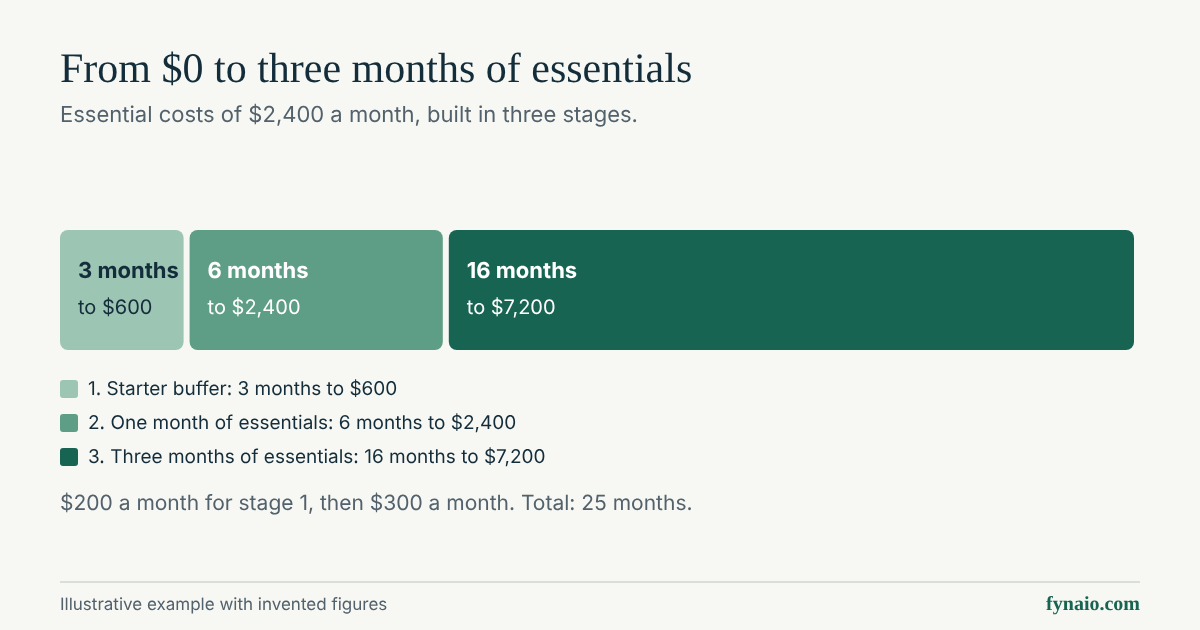
The second stage needs $1,800 more ($2,400 − $600), which takes 6 months at $300. The third needs $4,800 more ($7,200 − $2,400), which takes 16 months. If the household could save $400 a month after the starter stage instead, stage two would take 5 months (reaching $2,600) and stage three 12 months, finishing in 20 months rather than 25. Small increases in the monthly amount shorten the timeline noticeably, and one-off amounts do the same.
Ways to find the money
The CFPB suggests several strategies, and most people combine them:
- Make it automatic. Set up a recurring transfer for the day you are paid, so saving happens before spending. The CFPB notes that automatic recurring transfers are often one of the easiest systems.
- Match bills to your paydays. Managing the timing of money in and money out can reveal weeks when you can move a little extra into savings. Some providers will change a due date if you ask.
- Save one-off money. A tax refund, a cash gift or a bonus can complete a whole stage at once. The CFPB highlights tax refunds as one of the largest checks many people receive each year.
- Trim a recurring cost. Redirecting a subscription you no longer use turns a monthly charge into a monthly deposit. The guide to cancelling subscriptions shows how to find and stop them. The subscription cost calculator shows what each one costs over a year.
- Watch your progress. Checking the balance or keeping a running total makes the habit easier to keep.
Where to keep it
The CFPB says the fund should be safe, easy to reach and kept where you are not tempted to spend it on other things. A dedicated account at a bank or credit union is the most common choice: it keeps the money separate from your everyday checking. Before you choose one, check how long a transfer back to checking takes and whether withdrawals are limited or charged, because the money has to be reachable when the emergency happens. In the US, deposits at an FDIC-insured bank are insured to at least $250,000 at each insured bank; federally insured credit unions have similar coverage through the NCUA. Outside the US, check your own country’s deposit protection scheme.
Avoid putting emergency money where its value can fall when you need it, and avoid places that take days to access or charge you to withdraw. Keeping some cash at home is possible, but the CFPB notes that cash can be lost, stolen or destroyed.
Using it and refilling it
Decide your rules before an emergency happens, using the three questions above, and then use the fund without guilt when a real emergency arrives. That is what it is for. The CFPB points out that paying for a shock with borrowed money can make a one-time bill grow because of added costs and fees, which the fund helps you avoid.
After you use it, restart the deposits that built it. If the fund dropped below the starter level, rebuild that first, then continue toward your full target. Cutting back on optional spending for a few months can speed this up.
When this approach needs adjusting
- If you are behind on essential bills, catching up on housing, utilities or other necessities may need to come before building savings.
- If your income varies, base your essential costs and deposits on a lower-earning month, and save more in good months.
- If you have very little room, start with any amount. The CFPB notes that even a small amount can provide some financial security.
- If your costs change, such as a move or a new child, recalculate your target rather than relying on an old number.
To see where the monthly amount could come from, make a simple budget or try the 50/30/20 budget planner. For more ways to free up money, see how to save money, and use the savings goal calculator to set deposits that reach each stage by a date you choose.