A budgeting method is a rule for deciding where each dollar goes before you spend it. The six most used are the 50/30/20 split, other percentage splits such as 70/20/10 and 60/30/10, pay yourself first, zero-based budgeting, envelope budgeting and paycheck budgeting. None is best for everyone. The right one is the one that fits your fixed costs and that you will still be using in three months.
This guide compares them side by side, then runs one invented household through each method so you can see what the rules actually leave you with. Amounts are in US dollars and the US spending figures are labelled as US data. It is general budgeting education, not personal financial advice.
The six methods at a glance
| Method | How it works | Effort each month | Suits | Watch out for |
|---|---|---|---|---|
| 50/30/20 | 50% of take-home pay to needs, 30% to wants, 20% to savings and extra debt payments | Low | Steady pay where essentials fit in half of it | Fails on day one if essentials take more than half |
| 70/20/10 and 60/30/10 | The same idea with different shares; 70/20/10 groups needs and wants as living costs | Low | Higher fixed costs than 50/30/20 allows | Definitions vary from source to source, so write down what each share means for you |
| Pay yourself first | Move a set amount to savings on payday, then spend the rest freely after bills | Very low | People who dislike tracking | Says nothing about overspending once the transfer is made |
| Zero-based | Give every dollar of income a job until nothing is left unassigned | High | Tight months, debt payments, specific goals | Takes time to set up and to update when costs change |
| Envelope | A cash or digital envelope for each variable category; when it is empty, spending in it stops | Medium | Overspending in a few categories such as groceries or dining | Works for variable spending, not for bills paid by transfer |
| Paycheck | Plan each paycheck separately so every bill is covered on its due date | Medium | Weekly or every-two-weeks pay, bills clustered early in the month | A timing tool; you still need a split or a zero-based plan on top |
The percentage rules and pay yourself first decide how much goes where. Zero-based budgeting decides it line by line. Envelopes and paycheck plans control when and how the money is spent, so they are usually combined with one of the others.
One household, six methods
Jordan is an invented example with $4,000 a month in take-home pay. Jordan’s essentials are rent of $1,350, utilities and phone of $210, groceries of $450 and transport of $290, which come to $2,300. That is 57.5% of take-home pay ($2,300 ÷ $4,000).
| Method | Needs | Wants | Savings | Other set-asides |
|---|---|---|---|---|
| 50/30/20 as written | $2,000 | $1,200 | $800 | $0 |
| 50/30/20, wants absorb the gap | $2,300 | $900 | $800 | $0 |
| 60/30/10 | $2,400 | $1,200 | $400 | $0 |
| 70/20/10 | $2,300 | $500 | $800 | $400 |
| Pay yourself first, $600 | $2,300 | $1,100 | $600 | $0 |
| Zero-based, Jordan’s own plan | $2,300 | $800 | $600 | $300 |
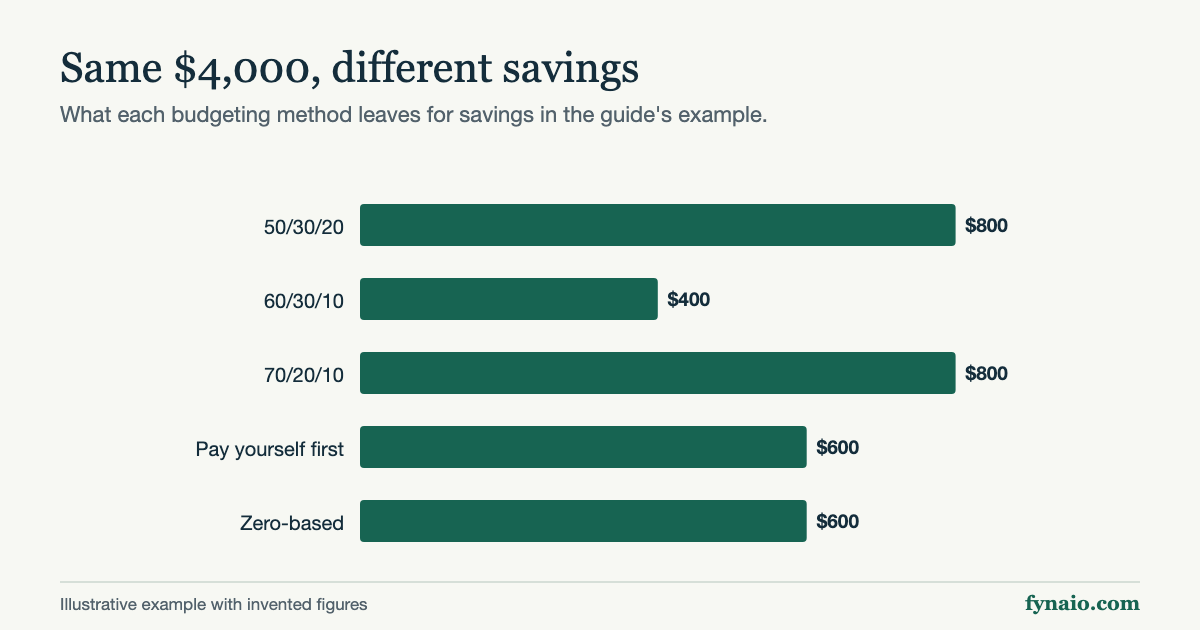
What the table shows:
- 50/30/20 as written gives needs $2,000, which is $300 less than Jordan’s essentials. Either the wants line shrinks to $900 to cover the gap, or the plan is broken before the month starts.
- 60/30/10 fits Jordan’s essentials with $100 to spare in the needs line, but saves only $400.
- 70/20/10 treats 70%, or $2,800, as living costs. After $2,300 of essentials, $500 is left for wants. Savings get 20% ($800) and the last 10% ($400) goes to giving or an extra goal. Some versions use the 20% for savings and extra debt payments together.
- Pay yourself first with a $600 transfer on payday leaves $3,400 for everything else, so $1,100 is left for wants after essentials.
- Zero-based is the plan Jordan writes line by line: $600 to savings and a $300 reserve for yearly bills such as car insurance, leaving $800 for wants.
Every row adds up to $4,000. The differences are not in the arithmetic but in what each rule makes Jordan decide: a percentage rule decides the savings amount for you, while zero-based budgeting makes you choose it.
Why many households cannot fit needs into 50%
US data shows why the 50% needs line is hard to hit. In its Consumer Expenditures release for 2025, published October 29, 2026, the US Bureau of Labor Statistics reports that average annual spending per consumer unit (roughly, a household) was $81,905. Housing took 33.9% of that spending, transportation 16.5%, food 13.0% and healthcare 7.9%, which together come to 71.3%.
These shares are of total spending, not of take-home pay, and not all of them are needs: the food figure includes restaurant meals and the housing figure includes furnishings. Even so, they show why a split with a larger first share, such as 60/30/10 or 70/20/10, exists. If your essentials are well above half of your pay, a different split is a more honest plan than a 50/30/20 budget you break every month.
How to choose a method in four questions
- What share of your take-home pay do essentials take? Divide your essential costs by your monthly take-home pay. Under 50%, the 50/30/20 split is a reasonable start. Between 50% and 70%, try 60/30/10, 70/20/10 or zero-based budgeting. Above 70%, every dollar needs a job, so zero-based budgeting is the clearer choice.
- Do you overspend in one or two categories? Put just those categories in envelopes, whichever method you use for the rest. The envelope budgeting guide shows a cash and a digital setup.
- Will you track spending at all? If not, pay yourself first is the method you are most likely to keep. Set the transfer for payday so the money moves before you see it.
- When does your money arrive? If you are paid weekly or every two weeks, add a paycheck budget so bills are covered on their due dates. If the amount changes from month to month, start from the guide to budgeting with irregular income.
Combining methods
Most budgets that last are a combination. A common one is pay yourself first for savings, a fixed list for bills, and envelopes for the two categories that tend to run over. In Jordan’s zero-based plan, the $800 for wants could be four envelopes: dining out $250, entertainment $200, clothing $150 and personal spending $200.
The 50/30/20 budget calculator lets you change the split, so you can test 60/30/10 or 70/20/10 against your own pay before you commit. For a line-by-line plan, the zero-based budgeting guide walks through a full month.
When to switch methods
- You have broken the plan three months in a row in the same way. That is a sign the rule does not match your costs, not a lack of willpower.
- Your pay or rent changed enough to move your essentials share past 50% or 70%.
- You have reached a savings goal and want a simpler method, or you have taken on a goal that needs a closer plan.
When you switch, keep last month’s actual spending as the starting point. The US Federal Trade Commission’s guide to making a budget suggests the same habit for any method: plan at the start of the month, check at the end whether you spent what you planned, and use that to plan the next month.
Limits of any budgeting method
Percentage splits are rules of thumb, not official standards, and the same name can mean different shares in different places. No method can fix a month in which essentials cost more than income; in that case the FTC guide’s advice is to look for things in the budget you can change. The BLS figures above describe average US spending, which may look very different from your own. If you are new to budgeting, the guide to how to make a budget covers the first month step by step.