Paycheck budgeting means planning each paycheck separately: before the money arrives, you decide which bills it will pay before the next payday and how much it must set aside for costs that come later. A monthly budget tells you whether income covers costs over the month. A paycheck plan tells you whether the money is there on the date each bill is due.
This guide shows how to build that plan step by step, with an invented example in US dollars for someone paid every two weeks. It is general budgeting education, not personal financial advice.
Why a monthly budget can still run short
A budget can balance over the month and still leave you short on a particular day. If rent of $1,250 is due on the 1st and your first paycheck of the month arrives on the 3rd, the money for rent has to come from last month’s paychecks. Paycheck budgeting makes that timing visible before it becomes a late payment.
If you have not yet set a monthly budget, start with the guide to how to make a budget, then come back to split it by paycheck.
Step 1: Put paydays and due dates on one calendar
The US Consumer Financial Protection Bureau’s bill calendar suggests gathering every bill you pay in a month, writing down the date each payment must be sent and adding the dates you receive income. It also suggests marking a mailed payment several days before the due date and an online payment two or three days before, so the payment arrives on time.
Use the date the money will leave your account, not only the due date. Include automatic payments, which are easy to forget because you never see a bill.
Step 2: Assign each bill to the paycheck before it
Go through the calendar and give each bill to the most recent paycheck before its payment date. Then add the regular spending that happens between paydays, such as groceries and transport, by splitting the monthly amount between paychecks.
Large bills that fall early in the month, like rent, usually need to be built up from the two paychecks before them. Keep that money set aside, ideally in a separate account or a clearly labelled balance, so it is still there on the due date.
Example: Riley’s two-paycheck plan
Riley is an invented example. Riley is paid $1,600 every two weeks after tax and divides one month’s costs between two paychecks. Rent for next month is built up from both paychecks so it is ready on the 1st.
| Line | Paycheck 1 | Paycheck 2 |
|---|---|---|
| Rent set aside for the 1st | $625 | $625 |
| Utilities (due the 10th) | $120 | $0 |
| Phone (due the 12th) | $60 | $0 |
| Car insurance (due the 20th) | $0 | $140 |
| Minimum debt payment (due the 25th) | $0 | $75 |
| Groceries | $200 | $200 |
| Transport | $80 | $80 |
| Personal spending | $150 | $150 |
| Savings goal | $75 | $75 |
| Left to assign | $290 | $255 |
| Total | $1,600 | $1,600 |
Across the month Riley has $3,200 and plans $2,655, leaving $545 to assign. Riley keeps the $290 from the first paycheck untouched until the second paycheck arrives, in case a bill is higher than expected, then decides where it goes. The amounts are illustrative, not typical costs.
Step 3: Check the running balance between paydays
The CFPB’s cash flow budget works week by week: start with the money you have, add income received, subtract expenses, and carry the ending balance into the next week. If the ending balance is negative, you are falling short that week.
Here is Riley’s plan from the example above as dated entries, starting from an empty checking balance in a 30-day month with paydays on the 3rd and 17th. Weekly spending on groceries, transport and personal items is shown as one line per paycheck period.
| Date | Entry | In | Out | Balance |
|---|---|---|---|---|
| 3rd | Paycheck 1 | $1,600 | $1,600 | |
| 3rd | Transfer to savings goal | $75 | $1,525 | |
| 10th | Utilities | $120 | $1,405 | |
| 12th | Phone | $60 | $1,345 | |
| 3rd to 16th | Groceries, transport and personal spending | $430 | $915 | |
| 17th | Paycheck 2 | $1,600 | $2,515 | |
| 17th | Transfer to savings goal | $75 | $2,440 | |
| 20th | Car insurance | $140 | $2,300 | |
| 25th | Minimum debt payment | $75 | $2,225 | |
| 17th to 30th | Groceries, transport and personal spending | $430 | $1,795 | |
| 1st | Next month’s rent | $1,250 | $545 |
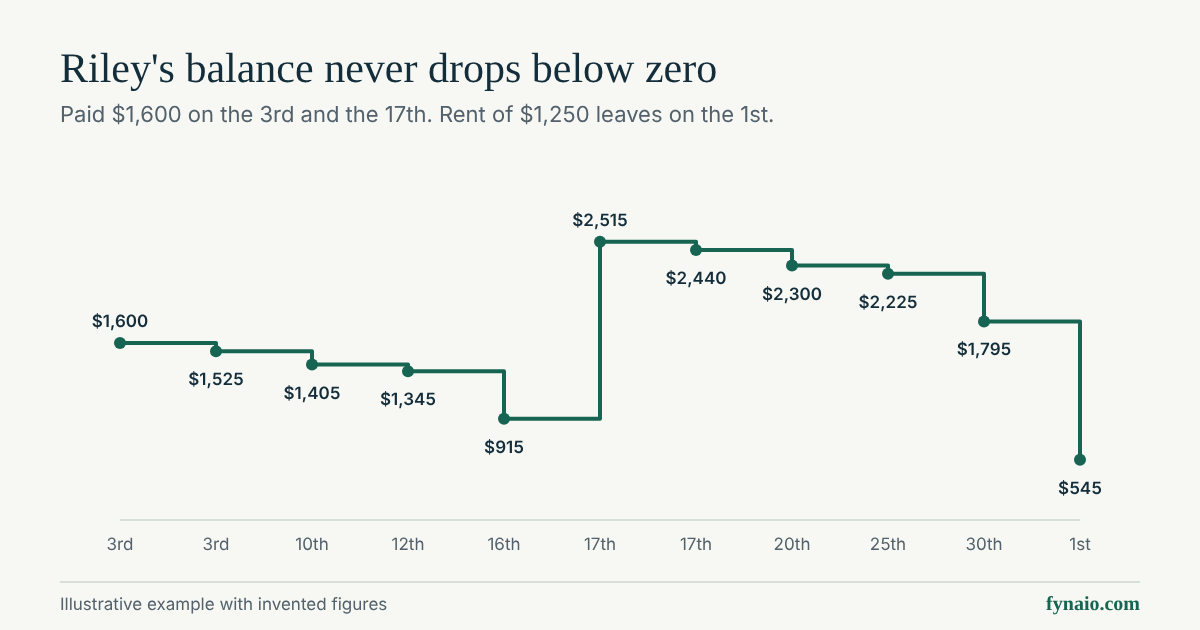
The balance never drops below zero, and the $545 left after rent matches the $290 and $255 left to assign in the plan. The $1,250 for rent sits in the balance for two weeks; if that makes it tempting to spend, move each $625 to a separate account on payday instead.
Do the same for each paycheck period. If one period comes up short even though the month balances, you have three options: move a flexible cost to the other paycheck, set aside more from the earlier paycheck, or ask the company whether the due date can be changed. The CFPB bill calendar suggests the last option when you have more bills than income in a given week; a change is not guaranteed.
Paid every two weeks, twice a month or weekly
- Every two weeks: 26 paychecks in most years, so most months have two and usually two months have three. Depending on where paydays fall, some years have 27.
- Twice a month (for example the 1st and 15th): 24 paychecks a year, always two a month, but the dates can shift when a payday falls on a weekend or holiday.
- Weekly: 52 paychecks in most years, so some months have four and some have five. Some years have 53. Check your employer’s actual pay dates rather than assuming a count.
To compare pay on different schedules, the salary to hourly calculator converts between weekly, every-two-weeks, twice-a-month and monthly amounts. Use your actual take-home pay in the plan, not your gross salary.
What to do with a third paycheck
If you are paid every two weeks and your plan already covers the month with two paychecks, a third paycheck is not needed for regular bills. Give it a job before it arrives: an emergency fund, a known yearly cost, or paying down a balance. For costs that come once or twice a year, the sinking funds calculator shows how much to set aside from each month.
Avoid building the third paycheck into regular spending. If your hours or pay change, a plan that relies on it can come up short.
Keep the plan simple to update
Write the plan in a notebook, a spreadsheet or the monthly budget template, with one column per paycheck. After each payday, check that the bills assigned to the previous paycheck were paid and move any surplus to the line you planned. If a bill changes, update the calendar first, then the paycheck it belongs to.