The fastest way to lower your electric bill is to find out which uses cost you the most, then change those first. For most homes that means heating and cooling, then hot water, then lighting and devices left on standby. You can work out what each one costs from two numbers: how many watts it uses and what you pay per kilowatt-hour.
This guide shows how to read your bill, price each appliance, and rank changes by the dollars they save. Prices and programs mentioned are US; the method works anywhere your bill shows energy used and a rate. The example is invented. It is general information, not advice for your particular home or utility.
Step 1: Find your rate on the bill
An electric bill usually has two parts: a charge for the energy you used, measured in kilowatt-hours (kWh), and fixed charges you pay whatever you use. To find what each extra kWh costs you, subtract the fixed charges from the total and divide by the kWh used. Some utilities charge different rates by time of day or by how much you use, so check whether your bill lists more than one rate.
For a sense of scale in the US: the US Energy Information Administration reports an average residential price of 18.16 cents per kWh in August 2026, up from 17.57 cents a year earlier, and that the average US residential customer used about 899 kWh a month in 2022. Put together, that is roughly $163 a month in energy charges before fixed charges and taxes. Treat it as a rough guide, because it mixes years and your own rate and use may be very different.
Step 2: Work out what each appliance costs
The US Department of Energy’s classroom guide Watt Does It Cost to Use It? uses two formulas: energy in kWh equals power in kilowatts times hours, and cost equals rate times energy. In everyday terms:
- kWh a month = watts × hours used a day × days used ÷ 1,000
- Cost a month = kWh a month × your rate per kWh
The same guide notes that the watts printed on a label are the most an appliance draws, not what it draws all the time, so your result can be higher than the real cost. That makes it a good way to find the big users, not an exact bill.
| Item | Watts | Hours a day | kWh a month | Cost a month |
|---|---|---|---|---|
| Space heater | 1,500 | 5 | 225 | $40.50 |
| Ten 60-watt bulbs | 600 | 4 | 72 | $12.96 |
| Ten 9-watt LED bulbs | 90 | 4 | 10.8 | $1.94 |
| Devices on standby | 50 | 24 | 36 | $6.48 |
All rows assume 30 days. Anything that makes heat, like a space heater, a dryer or an electric water heater, uses far more power than electronics, so it is usually the first place to look.
Example: Sam’s winter bill
Sam is an invented example. Last month Sam used 1,000 kWh at $0.18 per kWh, which is $180, plus a $12 fixed charge, for a $192 bill. Sam priced the items in the table above and made three changes.
| Change | kWh saved | Saved a month |
|---|---|---|
| Space heater 3 hours a day instead of 5 | 90 | $16.20 |
| Ten 60-watt bulbs swapped for 9-watt LEDs | 61.2 | $11.02 |
| Power strip turns standby devices off 20 hours a day | 30 | $5.40 |
| Total | 181.2 | $32.62 |
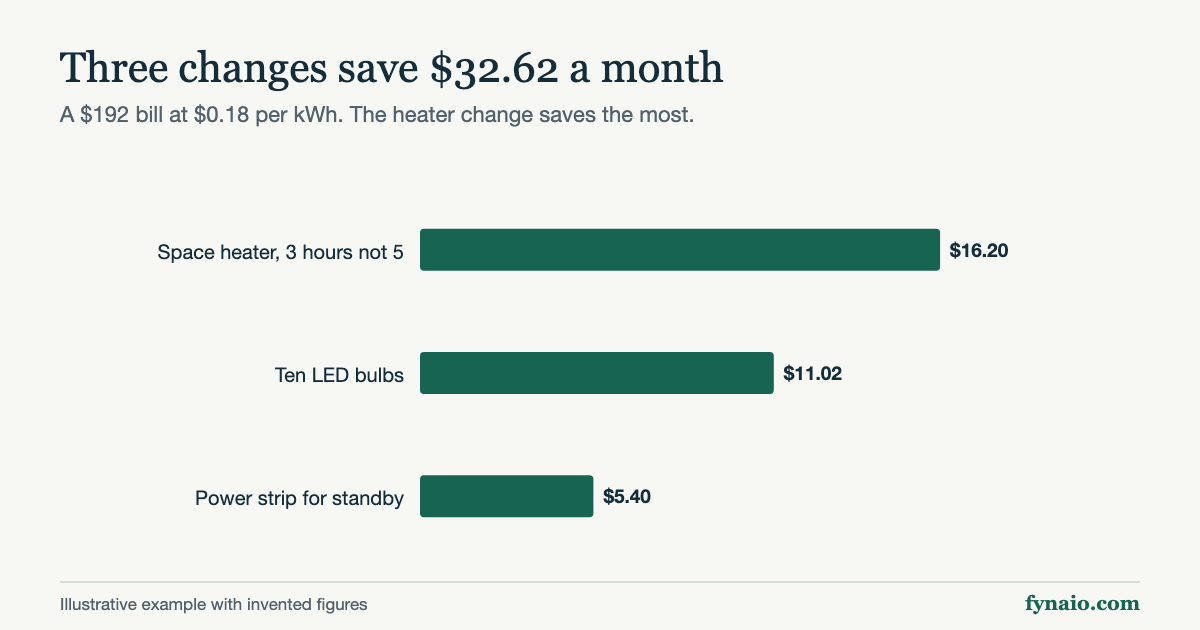
The bill falls from $192 to about $159.38: 818.8 kWh at $0.18 plus the same $12 fixed charge. The fixed charge does not change however little Sam uses, which is why cutting use lowers the bill by less than the same percentage of it. The heater change saved the most because it involved the most watts, even though it only cut two hours a day. Sam also has to stay warm, so turning the heater down only works if the room is used for less time or the heat stays in, which is where the next section comes in.
Heating and cooling: the biggest lever
The Department of Energy’s Energy Saver guide gives these figures:
- Thermostat: you can save as much as 10% a year on heating and cooling by turning the thermostat down 7°F to 10°F for 8 hours a day in fall and winter, and up in spring and summer. If you have a heat pump, the guide says not to do this without a smart or programmable thermostat designed for heat pumps.
- Air leaks: sealing uncontrolled air leaks can save 10% to 20% on heating and cooling bills. Caulk, weatherstripping and foam gaskets behind outlet covers are low-cost places to start.
- Ceiling fans: a fan lets you set the thermostat about 4°F higher in summer without feeling less comfortable. Turn fans off when you leave the room, because they cool people, not rooms.
These savings apply to the heating and cooling part of the bill only. If you heat with gas or oil, the thermostat saving shows up on that bill instead of the electric one.
Hot water
The same guide says water heating is the second largest energy expense in a home, typically about 18% of energy use. It suggests setting the water heater to 120°F, a temperature it describes as safe for most people, and says insulating hot water pipes can save another 3% to 4% a year on water heating. Using less hot water, such as washing clothes in cold water and full loads, cuts the cost directly.
Lighting and devices on standby
- LED bulbs: the guide says an ENERGY STAR certified LED bulb uses up to 90% less energy than an old incandescent bulb and lasts 15 to 25 times longer. Swap the bulbs you use most first.
- Standby power: many electronics keep drawing power when switched off, which the guide says can add 5% to 10% to a monthly utility bill. Advanced power strips with timers or switches cut that power when the devices are not in use.
Ask your utility and check for help
Ask your utility what plans it offers. Some offer rates that change by time of day, which can help if you can move laundry or dishwashing to cheaper hours, and some offer a fixed monthly payment that spreads winter and summer peaks across the year. A payment plan like that does not lower your total use, so keep the heating and cooling changes above.
In the US, if you are struggling to pay, USA.gov explains that the Low Income Home Energy Assistance Program (LIHEAP) can help with heating or cooling bills and with emergency services in an energy crisis, and that depending on where you live it may help with electric bills too. You apply through your state or territory’s LIHEAP office.
Plan for seasonal bills
Winter heating and summer cooling make some bills much larger than others. Look at the last 12 bills, total them, and compare the average with your highest month. Setting aside the difference in the months when the bill is low keeps the peak from breaking your budget. The sinking funds calculator works out a monthly set-aside, and the guide to budget categories shows where utilities fit in a monthly plan.
Limits of this approach
The appliance costs here use label watts and round hours, so they show which uses matter most rather than predicting your bill. The Department of Energy percentages are upper estimates for typical homes; your savings depend on your climate, home, equipment and rate. If you rent, sealing and water heater changes may need your landlord’s agreement. For more ways to cut regular costs, see the guide to how to save money.