A no-spend challenge is a short pause on purchases you choose to avoid, while you continue paying for necessities and commitments. To make it useful, name the categories you are pausing, write the exceptions before you start, and count the money still available after replacement costs and postponed purchases.
Start with seven days if a month feels difficult. The aim is to learn which purchases you can comfortably leave out, not to go without food, medicine or transport. This guide includes a complete practice week using invented US-dollar figures. It is general budgeting education, not a promised saving.
Choose a pause you can actually complete
Pick a normal week rather than one with a move, a medical appointment or a large family event. Write down why you are trying it: perhaps you want to stop ordering meals automatically or put a little more toward a known bill. Choose one or two categories if pausing every optional purchase would be unrealistic.
Look at recent transactions before deciding. The US Consumer Financial Protection Bureau’s spending tracker recommends recording spending and reviewing category totals. Use your own receipts to identify ordinary purchases you might avoid. A sale price on something you would never have bought is not a saving.
If almost all your spending already covers necessities, there may be little to pause. A challenge cannot fix a persistent gap between income and essential costs. Use the monthly budget guide to see the whole picture before adding a restriction.
Write the rules before the first day
Here is a sample rule sheet you can adapt. Make changes for your household rather than treating it as a universal list.
| Keep paying | Pause | Decide in advance |
|---|---|---|
| Housing, utilities and existing obligations | Decorative home purchases | A broken essential item may be replaced |
| Groceries and necessary household supplies | Routine takeout meals and bought coffee | Plan food for unusually long workdays |
| Medicine, care and necessary travel | Optional clothes, games and paid outings | Honor an agreed event budget or choose a different week |
Include the start date, finish date and paused categories on one page. Agree the rules with anyone affected. Do not cancel someone else’s planned spending or turn a shared household budget into a test they never accepted.
Check recurring charges separately: deciding not to shop will not stop a renewal. Follow the subscription cancellation guide if you want to end a service, and confirm its terms and cancellation date.
Prepare substitutes without buying a challenge kit
Choose meals from food you can safely use, pack what you need for work and pick a free activity you would enjoy. Keep necessary groceries in the plan; using the pantry does not mean skipping meals. The grocery budget guide can help separate food spending from takeout and household supplies.
Write tempting purchases on a later list with the price, reason and date. At the end of the week, ask whether you still need each item. A replacement you genuinely need remains a cost even if you buy it next Tuesday.
Measure the week without overstating savings
In this invented example, Sam plans to avoid $105 of ordinary optional purchases. These are assumed baseline purchases, not proof of what would otherwise have happened.
| Category | Usual amount | Spent during pause | Difference |
|---|---|---|---|
| Bought coffee | $20 | $4 | $16 |
| Takeout | $45 | $15 | $30 |
| Optional shopping | $40 | $0 | $40 |
| Total | $105 | $19 | $86 |
The $4 and $15 are additional home-drink and meal ingredients bought because of the challenge. They are already deducted, so do not subtract them again. Sam then buys a $25 item from the postponed shopping list. The remaining difference is $86 minus $25 = $61.
Before moving that $61 to a goal, Sam checks the next bills, pending transactions and ordinary food allowance. If another necessary cost needs it, it is not spare cash. If pantry food was used, record that too: replacing it later can reduce the apparent saving. For a fair comparison, check the following week’s spending rather than ending the measurement on the last challenge day.
Use a two-minute daily record
- Write the purchase you considered and the category it belongs to.
- Record what you actually spent, including substitutes and exceptions.
- Mark a deferred purchase as deferred, not permanently avoided.
- Note what prompted it: convenience, a reminder, hunger or a planned need.
- Continue after an unplanned purchase; adjust the rule if it was unrealistic.
A missed day does not erase the rest of the experiment. Do not compensate by skipping a necessary expense. The record should explain the result, not reward an unbroken streak at any cost.
Record the follow-up week too
The week after the challenge shows whether money was saved or only delayed. Keep the same categories for seven more days, and add two lines: postponed purchases and pantry items you replaced. In Sam’s invented follow-up week:
| Line | Usual for two weeks | Actually spent |
|---|---|---|
| Challenge week, all categories | $105 | $19 |
| Postponed item bought afterwards | $0 | $25 |
| Follow-up week: coffee, takeout, shopping | $105 | $100 |
| Pantry items replaced | $0 | $12 |
| Total | $210 | $156 |
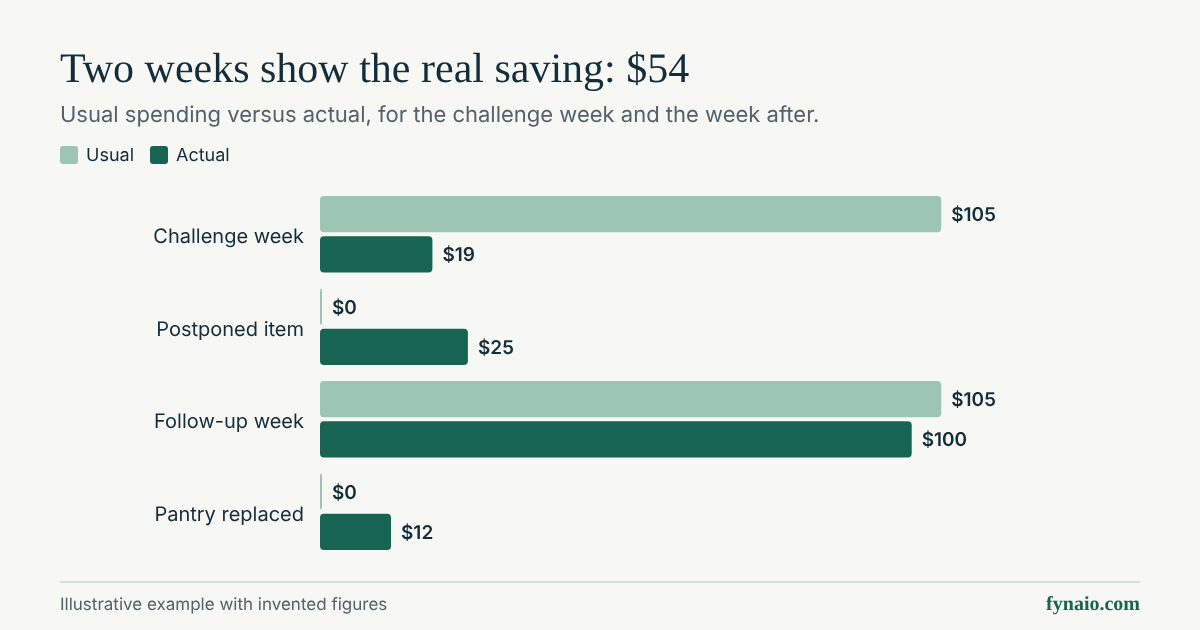
Over two weeks Sam spent $54 less than usual, not the $86 the challenge week alone suggested. That $54 is the figure to move to a goal. If the follow-up week had run well above usual, the honest result could be close to zero, which is still useful to know.
Decide what survives after the challenge
At the end, keep one change that was easy enough to repeat. You might continue bringing lunch twice a week while restoring a modest outing budget. Wait to see whether it changes actual spending before assuming every future week will save the same amount.
Give any confirmed spare money a named purpose. The CFPB’s savings plan worksheet connects a goal to a weekly set-aside. A seven-day challenge can contribute to that plan, but it does not establish a reliable ongoing deposit by itself.