A Christmas budget is one spending total for the whole season, split into gifts, food, decorations and the small extras that add up, then saved in weekly amounts before you start shopping. Base the total on what you can afford without touching bill money or your emergency fund, not on what other people spend. Then turn the gift part into a list with an amount next to each person.
The same plan works for Hanukkah, Kwanzaa or any winter holiday. This guide uses US survey data and an invented household in US dollars.
What US shoppers say they plan to spend
In the National Retail Federation’s 2026 holiday survey of 8,094 US adults, conducted October 1 to 7, 2026, 56% of holiday shoppers said the economy would affect their spending plans. Of those, 43% planned to shop for sales more often and 29% planned to use coupons more often. The 2026 announcement does not give an average amount per person.
The most recent per-person figure comes from NRF’s 2025 holiday survey of 8,247 US adults, in which people planned to spend $890.49 each on average: $627.93 on gifts for family and friends and $262.56 on food or candy, decorations and greeting cards. These are planned amounts averaged across very different households. They are not a recommendation, and they do not show what anyone actually spent.
In 2026, 43% of shoppers planned to start before November (42% in 2025), and half of those early shoppers said they did so to spread out their holiday budgets. Starting early only helps if the money is planned as well, which is what the steps below do.
Step 1: Set one total you can afford
Start from your own numbers. Look at last November and December on your bank and card statements and add up gifts, food, travel and anything else the season cost. Then compare that figure with what you can realistically set aside between now and your first purchase.
Two sources of money should stay off-limits. Bill money for rent, utilities and other fixed costs is already spoken for, and an emergency fund has a different job. The Consumer Financial Protection Bureau describes an emergency fund as a cash reserve set aside for unplanned expenses or financial emergencies; the holidays arrive on the same date every year. If you do not have that reserve yet, the emergency fund guide explains how to start one, and a smaller holiday total may be the right trade-off this year.
Step 2: Split the total into categories
Gifts are usually the biggest line, but rarely the only one. Give each of these its own amount:
- Gifts for family, friends, children’s teachers, coworkers and any gift exchanges.
- Food and hosting, including special meals, treats and anything you bring to someone else’s celebration. The USDA Economic Research Service’s Food Price Outlook forecast in October 2026 that grocery prices would rise 2.3 percent over the year, so last year’s food figure may need a small increase.
- Decorations, whether new ones or replacements.
- Cards, wrapping and postage, which are easy to forget because each purchase is small.
- Travel to see family: fuel, tickets, parking or a pet sitter.
- Giving, if you donate or contribute to a collection at work.
The budget categories list covers other irregular costs that are easy to miss when you plan a month like December.
Step 3: Turn the gift line into a list
A gift budget becomes real when every person on the list has a number next to their name. Write the list before you shop, total it and compare it with the gift line from Step 2. If the list comes to more, change the list rather than the total.
A gift sheet you can reuse every year needs five columns: the person, the budget, the gift idea, the amount actually spent including postage, and the date bought. The last two columns are what make next year’s plan easier, because they show which budgets were realistic.
Example: a $900 holiday plan saved over 10 weeks
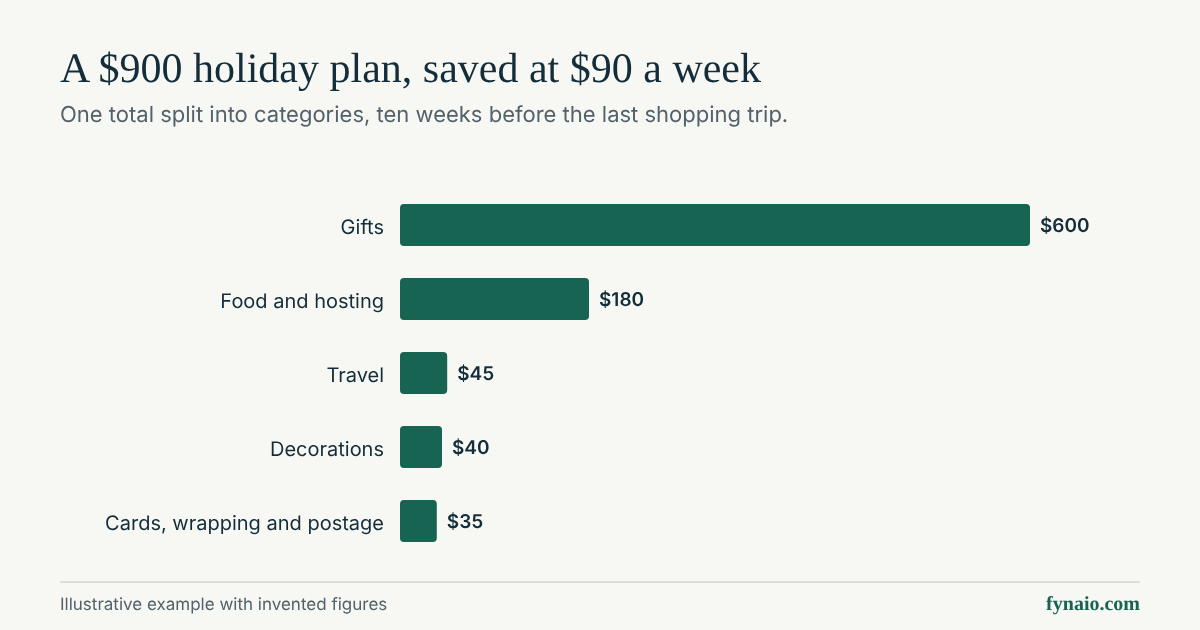
This invented household starts planning in mid-October, about ten weeks before its last shopping trip. It sets a $900 total from last year’s statements and what it can save, then splits it:
| Category | Amount |
|---|---|
| Gifts | $600 |
| Food and hosting | $180 |
| Decorations | $40 |
| Cards, wrapping and postage | $35 |
| Travel | $45 |
| Total | $900 |
The $600 gift line becomes this list:
| Person | Budget |
|---|---|
| Partner | $150 |
| Older child | $120 |
| Younger child | $120 |
| Parents (one shared gift) | $80 |
| Two siblings ($30 each) | $60 |
| Teachers and coworkers (five at $10) | $50 |
| Office gift exchange | $20 |
| Total | $600 |
Saving $90 a week for ten weeks covers the $900. Starting on December 1 instead, with three weeks left, the same plan would need $300 a week. If that does not fit, the household shrinks the list or the food line before shopping starts, rather than paying for December out of January’s money.
How much to save for Christmas each week
Weekly amount = holiday total ÷ weeks left before your last shopping trip. Subtract anything you have already set aside first. For the $900 example above:
- 10 weeks left: $90 a week.
- 8 weeks left: $112.50 a week.
- 6 weeks left: $150 a week.
- 5 weeks left: $180 a week.
- 3 weeks left: $300 a week.
If the weekly amount is more than you can set aside, lower the total now, starting with the gift list, rather than covering the gap after the holidays.
Check early purchases against what you have saved
Not everything is bought on the last trip. Gifts posted to family far away, early sales and travel tickets are paid weeks before December, and the weekly amount only works if enough has built up by then. At $90 a week, the example household has $270 saved after three weeks. If it wants to buy $360 of gifts in week three, including postage, it is $90 short. It can move that purchase to week four, when $360 is saved, or set aside more in the first few weeks. Put the date of each big purchase next to the running total before you start.
Set the money aside before you shop
- Move it on payday. Transfer the weekly or per-paycheck amount to a separate savings account, or a labelled envelope, as soon as you are paid. In the example, $90 a week is $180 for each payday if you are paid every two weeks.
- Keep it apart from everyday money. A gifts-and-occasions envelope works well for this; the envelope budgeting guide shows how to run one in cash or digitally.
- Start next year’s fund in January. Spread over 12 months, the same $900 is $75 a month. The sinking funds calculator works out the monthly amount for any future cost and date.
Shop from the list, not the shelf
- Track as you buy. Write the price next to each name the day you buy the gift. If one comes in under budget, move the difference to someone who still needs a gift, not to an extra purchase.
- Count shipping and returns. A low price with expensive shipping can cost more than buying locally. Check the return policy and keep receipts until return windows close.
- Check gift cards before you buy them. The Federal Trade Commission warns that scammers tamper with gift cards in store displays to steal the card number and PIN. Look for scratched backs or missing stickers, and keep a copy of the card and the store receipt.
- Research unfamiliar online sellers. The FTC suggests searching for the seller’s name along with words like “review”, “complaint” or “scam” before you buy, keeping your receipt and order confirmation, and being wary of any seller that will only take a gift card, wire transfer, payment app or cryptocurrency.
When the total does not fit
- Agree on a cap with family. A spending limit per gift, or gifts for children only, lowers the pressure on everyone.
- Swap individual gifts for an exchange. Drawing names turns many small gifts into one each.
- Give time or skills. A cooked meal, an evening of babysitting or a repair can mean as much as something bought.
- Trim categories before people. Fewer new decorations or a simpler meal can protect the gifts that matter most.
- Keep bills and the emergency fund out of it. A smaller holiday is easier to recover from than a missed rent payment.
This is general education, not personal financial advice.
After the holidays
In early January, compare what you spent with each line of the plan and note where you went over; that is next year’s first adjustment. Then set next year’s total and start the monthly set-aside, so next December is already paid for when it arrives.
Download a Christmas budget spreadsheet
To skip the setup, download the Christmas budget spreadsheet with the $900 example above already in place. It opens in Excel, Google Sheets or LibreOffice with working formulas:
- Save each week divides the holiday total by the weeks left, so entering 900 and 10 shows 90. Change the weeks to 5 and it shows 180.
- Each line has Planned, Spent and Left columns. Type what a gift or the food shop actually cost into Spent, and Left shows what remains on that line, so an overspend on one gift is visible before the next purchase.
- Not yet given a line subtracts the planned lines from the total. It shows 0 for the example; if it turns negative after you add a person, take the difference out of another line before shopping.
Replace the example names and amounts with your own, and add rows above the Total line if you need more; extend the sums to include them. The file stays on your device; nothing is sent to Fynaio.
Your holiday budget checklist
- Add up what last year’s holidays cost from your statements.
- Set one total you can save without using bill money or your emergency fund.
- Split it into gifts, food and hosting, decorations, cards and postage, travel and giving.
- Write a gift list with an amount for each person and make it fit the gift line.
- Divide the total by the weeks or paydays left and move that amount each time.
- Track each purchase against the list and keep receipts.
- Check gift cards for tampering and research unfamiliar sellers.
- In January, compare plan and spending and start next year’s fund.