A moving budget answers one question: how much cash do you need ready before moving day? The total is usually bigger than the moving company’s estimate, because the new home often wants a security deposit and first month’s rent at the same time, and those are due before you get any deposit back from the old place. This guide shows how to list every cost, separate money you spend from money that is only tied up, and turn the total into a weekly saving target.
The example uses invented figures in US dollars, not typical prices. Moving costs vary widely with distance, volume and season, so use your own quotes.
List every cost, not just the movers
Write down everything the move will cost from the day you start packing until the first week in the new home:
- Moving the belongings: a moving company, a rental truck and fuel, or help from friends.
- Packing: boxes, tape and protective materials.
- Leaving the old home: cleaning, small repairs and any fees in your lease.
- Getting there: travel, fuel, meals on the road and an overnight stay for a long move.
- Setting up the new home: utility or internet setup fees, new keys, and the basic supplies you need in the first week.
- Money the new home asks for upfront: a security deposit and first month’s rent, and sometimes application fees.
Ask the new landlord exactly what is due and when. Write the amounts down rather than assuming.
Separate spent costs from money tied up
A security deposit is different from a moving cost: you may get it back when you leave, but you still need the cash on the day you sign. Your old deposit can help with the next move only after it is actually returned, and part of it can be kept for damage or unpaid charges. Plan as if the old deposit arrives late, and count it only when it is in your account.
Example: Morgan’s moving budget
Morgan is an invented example, planning a local move to a rental with $1,250 monthly rent.
| Item | Amount |
|---|---|
| Moving company (written estimate) | $1,400 |
| Packing supplies | $120 |
| Cleaning the old home | $150 |
| Travel and fuel | $180 |
| Utility and internet setup | $100 |
| First-week food and supplies | $150 |
| Buffer (10% of the costs above) | $210 |
| Security deposit at the new home | $1,250 |
| First month’s rent | $1,250 |
| Total cash needed | $4,810 |
The spent costs come to $2,100, and Morgan adds a 10% buffer of $210 because the final bill can differ from an estimate. The deposit and first month’s rent add $2,500. Morgan’s old deposit is not counted.
Turn the total into a weekly target
Morgan has $1,600 saved and moves in 8 weeks. The amount still needed is $4,810 − $1,600 = $3,210, and $3,210 ÷ 8 = $401.25 a week. The CFPB’s savings plan worksheet uses the same idea: divide the amount you need by the weeks you have.
The savings goal calculator does this for you with your own target date and existing savings. If the weekly amount is not realistic, the options are to move later, cut the costs you control, or choose a cheaper new home. The rent affordability calculator shows whether the new rent fits your income once the move is over.
Check the payment dates, not only the total
Moving costs are not all paid on moving day. Put each payment on a calendar and compare it with what will be saved by then. In this invented schedule, Morgan saves $401.25 a week on top of the $1,600 already saved:
| When | Payment | Paid so far | Saved by then |
|---|---|---|---|
| Week 2 | Mover booking deposit, $200 | $200 | $2,402.50 |
| Week 3 | Security deposit at lease signing, $1,250 | $1,450 | $2,803.75 |
| Week 6 | Packing supplies, $120 | $1,570 | $4,007.50 |
| Week 8 | Mover balance, first month’s rent, cleaning, travel, setup, first-week food and buffer, $3,240 | $4,810 | $4,810.00 |
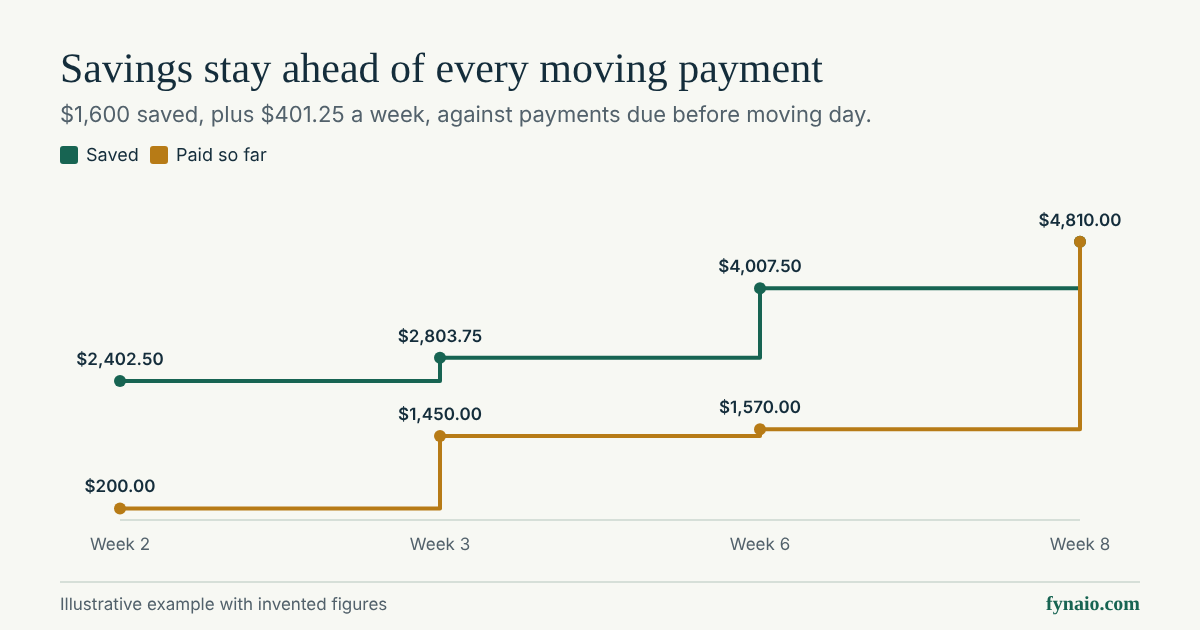
Here the savings stay ahead of every payment. If the landlord wanted the $1,250 deposit in week 1 and Morgan had nothing saved yet, the total would still balance by week 8 but the deposit would not be covered on the day it is due. That is the situation to spot early.
Get moving quotes in writing
For moves between US states, the Federal Motor Carrier Safety Administration’s moving checklist advises getting estimates from at least three movers or brokers and comparing both cost and services. It also advises finding out the mover’s responsibility for damage, reading the estimate, bill of lading and inventory before signing, and keeping the bill of lading until the goods are delivered, charges are paid and any claims are settled.
The same checklist notes you pay the driver according to the terms of your written binding or non-binding estimate before your goods are unloaded. Check which kind of estimate you have, because it affects how much the final bill can change, and keep that payment ready in your budget. Rules for moves within one state can differ, so check your state’s requirements for local moves.
When you compare quotes, put them side by side on the same lines so a low headline price does not hide extra charges: whether the estimate is binding, the hourly or flat rate and any minimum hours, travel or fuel fees, charges for stairs, long carries or heavy items, packing materials, the mover’s liability for damage, the deposit and the cancellation terms.
Keep the move from emptying your emergency fund
A move is a planned cost, so try to save for it separately rather than using your emergency fund. If you do use emergency savings, plan to rebuild them after the move; the emergency fund guide explains how to set a target. Watch for overlap months, when rent on the old and new homes is due at the same time, and include the extra rent in the move budget if it applies to you.