Budgeting as a couple starts with one shared list of household costs and one agreed way to pay for them. The hardest part is usually not the arithmetic but the fairness question: when one partner earns more, should shared bills be split equally or in proportion to income? This guide works through both, with invented figures in US dollars, so you can see what each person has left before you decide.
It is general budgeting education. It does not cover legal, tax or account-ownership questions, which depend on where you live and your circumstances.
Start with a list of shared costs
Sit down together with recent bills and statements. The FTC’s guide to making a budget describes the basic steps: list your bills and expenses, write down monthly income, then subtract expenses from income. Do the same for the household, but sort each cost into one of three groups:
- Shared: costs you both benefit from, such as rent, utilities, groceries and household supplies.
- Individual: each person’s own spending, such as personal phone plans, hobbies or clothes.
- Existing commitments: debts or obligations one person had before, which you may decide to keep separate or share.
If you do not know where the money goes now, each of you can use the CFPB’s spending tracker for a few weeks first. The list of budget categories can help you agree what counts as shared.
Equal split or proportional split
In this invented example, Alex takes home $3,600 a month and Sam takes home $2,400. Their shared costs come to $3,000 a month.
| Split | Alex pays | Sam pays | Alex has left | Sam has left |
|---|---|---|---|---|
| Equal (50/50) | $1,500 | $1,500 | $2,100 | $900 |
| Proportional (60/40) | $1,800 | $1,200 | $1,800 | $1,200 |
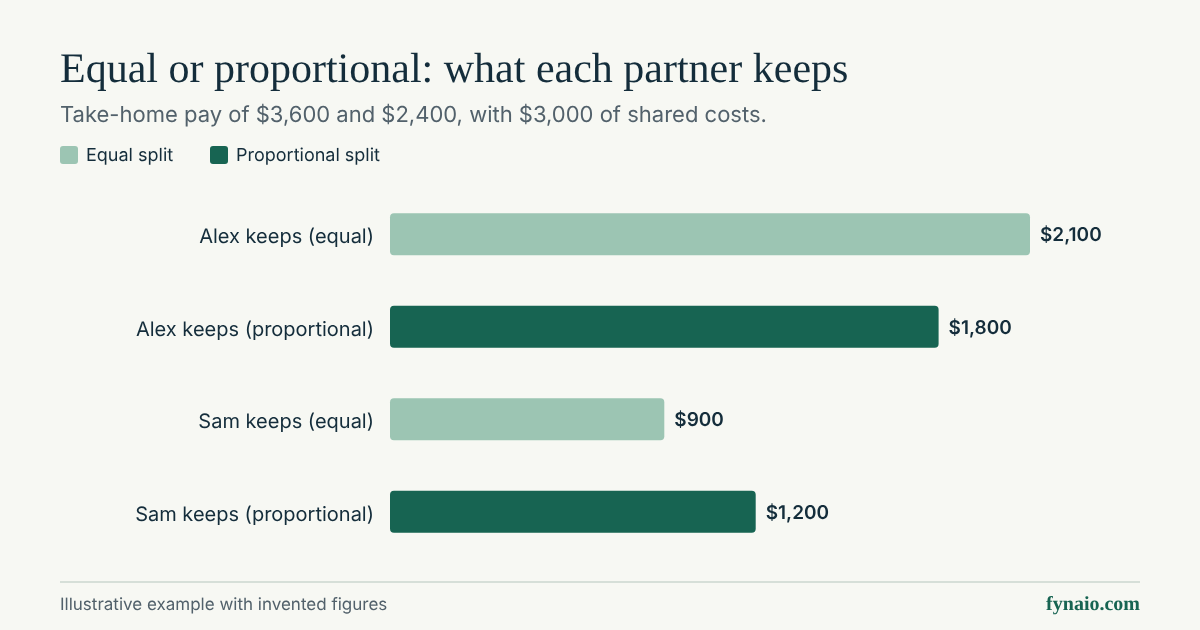
With an equal split, each pays the same amount, but Sam is left with less than half of what Alex keeps for everything else. With a proportional split, each pays the same share of their income: Alex earns 60% of the household’s $6,000, so Alex pays 60% of shared costs. Both then keep half of their own pay.
To work out a proportional share, divide your income by your combined income, then multiply by the shared costs. For Alex: $3,600 ÷ $6,000 = 0.6, and 0.6 × $3,000 = $1,800.
To keep the split current in a spreadsheet, put each person’s take-home pay in A2 and B2 and the shared costs in C2. Then =A2/(A2+B2)*C2 gives the first person’s share and =C2-D2, entered in E2 if the first share is in D2, gives the second person’s. When either income or the shared costs change, both amounts update together.
Neither split is automatically right. Some couples prefer equal amounts for simplicity, some prefer proportional amounts so lower pay does not mean much less personal money, and some pool everything into one budget. What matters is that you both choose it and can afford it.
A proportional split also has limits. It looks only at pay, not at unpaid work such as childcare or running the home, at debts one person brought into the relationship, or at savings either of you already has. If one of those matters in your household, talk about it directly rather than expecting a formula to settle it.
Decide how the money moves
Agree on the practical side as well as the percentages:
- Who pays each shared bill, and from which account.
- When each person transfers their share, ideally soon after payday and before the bills are due.
- How much each person can spend without checking with the other.
- Which shared goals you are saving for, and how much each contributes.
Put the shared bills on one calendar so neither of you is surprised by a payment. The CFPB’s bill calendar is a simple way to see which bills come due in each week. Writing the agreement down in a short note or a shared monthly budget template makes it easier to check later.
When one income changes
A fixed split can become unaffordable when one partner’s pay falls. In the example, suppose Sam’s take-home pay drops to $1,800. Combined income is now $5,400.
- Under the equal split, Sam would still pay $1,500 and keep only $300 for everything else.
- Under a proportional split, Alex’s share becomes $3,600 ÷ $5,400 of $3,000, which is $2,000, and Sam’s becomes $1,000.
Agree in advance that you will review the split whenever either income, or a major shared cost, changes. Also agree how you will handle a month when one of you cannot pay their share, so it does not turn into a missed bill.
Plan for costs that do not come every month
Many disagreements start with a large bill nobody planned for: car insurance, a holiday, or a household repair. List the known yearly costs together and decide how they are split, then set aside a monthly amount for each with the sinking funds calculator. An agreed emergency reserve for the household, separate from each person’s own savings, helps with costs you cannot predict; the emergency fund guide explains how to size it.
Write the agreement down
A short written agreement, kept where you can both see it, avoids arguing later about what was decided. It needs only a few lines:
- Which costs are shared and which are personal.
- The split method (equal, proportional or pooled) and each person’s amount this month.
- How and when the money moves, such as a transfer to a joint account on each payday.
- How much each person can spend on personal things without asking.
- The amount above which a purchase is discussed first.
- What happens if either income drops or stops.
- The date of the next review.
This is a household arrangement, not a legal agreement; if you need one, for example around property or separation, get advice where you live.
Make the money talk a routine
A short monthly check-in works better than a long argument after a problem. Look at what was spent against the plan, upcoming bills and whether either person’s situation has changed. Keep it about the numbers and the agreement, not blame. If you cannot agree on a split, try one method for three months and review it with real figures.